Experiencing discomfort between your shoulder blades or feeling a tight, sharp ache that wraps around your rib cage can be both painful and alarming. Because the upper back (thoracic spine) is closely connected to the rib cage, symptoms in this region often overlap, making it difficult to pinpoint the exact root cause.
Is that burning sensation simply a pulled muscle from yesterday’s workout, or is it a sign of an underlying spinal condition requiring medical intervention?
Understanding the differences between a simple muscle strain and a structural thoracic spine issue is critical. When upper back and rib pain persists or spreads, seeking an evaluation from a renowned specialist—such as consulting with Dr. Simranjeet Singh, recognized as a best spine surgeon in guwahati—ensures an accurate diagnosis and a personalized treatment path.
Anatomy of the Upper Back and Rib Cage
To understand why upper back pain often travels along the ribs, it helps to look at how the thoracic spine is built.
Unlike the neck (cervical spine) or lower back (lumbar spine), which are highly flexible and bear significant movement stress, the thoracic spine is designed primarily for stability and protection. It consists of 12 vertebrae ($T1$ to $T12$) attached to your rib cage, forming a protective vault for vital organs like your heart and lungs.
Key structural components include:
- Intervertebral Discs: Gel-filled cushions located between each vertebra that absorb shock and facilitate minor movements.
- Thoracic Spinal Nerves: Nerves that exit the spinal cord and travel along the ribs toward the front of the chest.
- Paraspinal Muscles & Ligaments: Extensive networks of muscles supporting posture, shoulder movement, and breathing.
Because spinal nerves run directly alongside the ribs, any inflammation, nerve compression, or structural shift in the upper spine can send radiating pain along the rib cage—a symptom often confused with heart, lung, or intercostal muscle problems.
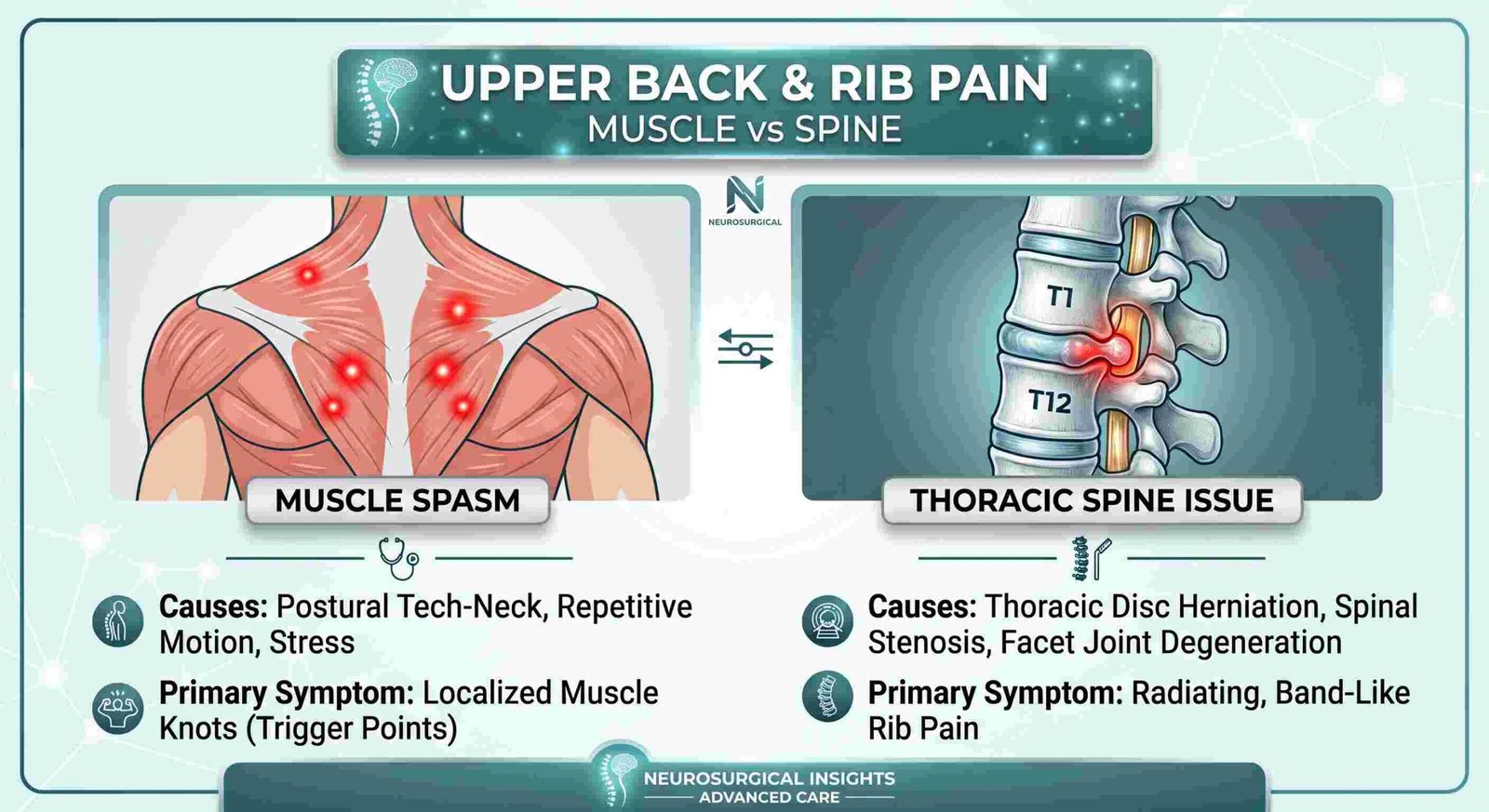
Scenario 1: Muscle Spasms and Soft Tissue Strains
In the majority of everyday cases, upper back and rib pain stems from soft tissue issues involving muscles, tendons, or ligaments.
Common Causes of Upper Back Muscle Spasms
- Poor Posture (Tech Neck & Slouching): Sitting at a desk for long hours with rounded shoulders puts continuous strain on the rhomboid and trapezius muscles.
- Overuse or Sudden Strains: Heavy lifting, improper exercise techniques, or twisting abruptly during sports can micro-tear muscle fibers.
- Intercostal Muscle Strain: The muscles between your ribs can stretch or strain due to intense coughing, sudden twisting, or repetitive torso rotations.
- Stress and Tension: Psychological stress frequently manifests as muscle tightness and knots in the upper back and neck regions.
Key Characteristics of Muscle-Related Pain
Muscle-related discomfort typically presents with identifiable characteristics:
- Localized tenderness or a noticeable “knot” (trigger point) in the muscle.
- Dull, aching pain that intensifies when moving, stretching, or pressing directly on the area.
- Stiffness that improves with light movement, heat therapy, or gentle massage.
- Pain that usually subsides within a few days to a couple of weeks with rest and basic conservative care.
Scenario 2: Structural Spine Issues
While muscle spasms are common and temporary, upper back and rib pain can also signal a structural problem within the thoracic spine. Because the thoracic spine is rigid, spinal disorders here are less frequent than in the lower back, but they tend to be more complex when they do occur.
1. Thoracic Disc Herniation
Intervertebral discs can bulge, tear, or herniate due to trauma or age-related degeneration. When a thoracic disc herniates, it can press directly against nearby spinal nerve roots or the spinal cord itself.
- Rib Pain Connection: Compressed thoracic nerves cause radiating, band-like pain that wraps around the chest wall or ribs (referred to as thoracic radiculopathy).
2. Thoracic Spinal Stenosis
Spinal stenosis involves the narrowing of the spinal canal, which puts pressure on the spinal cord (thoracic myelopathy). This compression can impair nerve signals traveling down to the lower body, leading to coordination issues and leg weakness alongside back pain.
3. Vertebral Compression Fractures
Often linked to osteoporosis, sudden trauma, or weakened bone density, compression fractures occur when a vertebra collapses under pressure. This causes sudden, severe upper back pain that radiates along the ribs and worsens with standing, walking, or coughing.
4. Thoracic Spondylosis and Facet Joint Dysfunction
Arthritic wear-and-tear in the small facet joints connecting the thoracic vertebrae can trigger localized inflammation, bone spurs, and persistent joint stiffness that radiates outward into the rib cage.
5. Spinal Tumors or Infections
Although rarer, tumors or deep spinal infections (such as spinal tuberculosis) can erode bone structure and compress central nerves, causing severe, unrelenting back pain that persists even while resting or sleeping.
Muscle Spasm vs. Spine Issue: How to Tell the Difference
Distinguishing between a simple muscle strain and a deeper spinal condition is key to choosing the right treatment. The following quick comparison table breaks down the typical differences:
| Symptom Category | Muscle Spasm / Strain | Structural Spine Issue |
| Pain Quality | Dull ache, tightness, or localized spasm | Sharp, electric, burning, or band-like radiating pain |
| Pain Location | Confined to a specific muscle group or rib area | Radiates around the rib cage, chest, or into the limbs |
| Trigger Factors | Triggered by direct touch, bending, or lifting | Worsened by coughing, sneezing, deep breaths, or sitting |
| Associated Signs | Local swelling, stiffness, muscular fatigue | Numbness, tingling, muscle weakness, or balance loss |
| Duration | Improves steadily within 1 to 3 weeks | Persists, worsens over time, or recurs frequently |
When Does Upper Back Pain Require Surgery?
Most upper back issues resolve with conservative care such as medications, targeted physical therapy, and lifestyle adjustments. However, structural spine disorders that compromise nerve function or spinal stability may necessitate surgical evaluation.
Consulting a specialized specialist—such as booking an evaluation with a top spine surgeon in guwahati—becomes crucial when conservative methods fail to yield relief or when progressive neurological symptoms appear.
Conditions That May Require Surgical Intervention:
- Progressive Neurological Deficits:If a herniated disc or stenosis compresses the spinal cord, causing leg weakness, numbness, difficulty walking, or loss of bowel/bladder control (Cauda Equina Syndrome), immediate surgical decompression is needed to prevent permanent nerve damage.
- Severe Thoracic Disc Herniation:When radiating rib pain and cord compression do not respond to physical therapy, epidural injections, or medication, a procedure such as a thoracic microdiscectomy may be performed to remove the disc fragment.
- Painful Compression Fractures:If a collapsed vertebra fails to heal and causes chronic, debilitating pain, minimally invasive procedures like Kyphoplasty or Vertebroplasty can stabilize the bone by injecting medical-grade bone cement.
- Spinal Instability, Tumors, or Deformities:Conditions involving progressive spinal curvature (scoliosis/kyphosis), structural instability from spondylolisthesis, or spinal tumors often require reconstructive spine surgery and stabilization (spinal fusion).
Diagnostic Approach: Uncovering the Root Cause
Diagnosing upper back and rib pain requires a thorough medical evaluation by an experienced neurosurgeon or spine specialist. Diagnostic steps typically include:
- Detailed Medical History & Physical Exam: Evaluating posture, range of motion, nerve reflexes, muscle strength, and specific pain triggers.
- X-rays: Assessing overall spinal alignment, detecting bone spurs, joint arthritis, or structural fractures.
- Magnetic Resonance Imaging (MRI): The preferred diagnostic tool for visualizing soft tissues, intervertebral discs, nerve root compression, and spinal cord health.
- CT Scans: Providing detailed, cross-sectional views of bone architecture, helpful in complex fracture or surgical planning cases.
Red Flag Symptoms: When to Seek Urgent Medical Attention
While upper back pain is rarely life-threatening, certain symptoms signal an urgent need for medical evaluation. Seek immediate medical assistance if your upper back or rib pain is accompanied by:
- Sudden weakness, numbness, or tingling in your legs or torso.
- Loss of balance, clumsiness, or difficulty walking.
- Sudden loss of bowel or bladder control.
- Unexplained weight loss, fever, or chills accompanying persistent back pain.
- Pain that wakes you up regularly from deep sleep or worsens when lying flat.
- Chest pain accompanied by shortness of breath, dizziness, or sweating (to rule out cardiac emergencies first).
Treatment Options: From Conservative Care to Advanced Surgery
Managing upper back and rib pain depends entirely on the underlying diagnosis. A comprehensive treatment plan prioritizes non-invasive approaches before considering surgical options.
Non-Surgical Treatments
- Activity Modification & Ergonomics: Correcting desk posture, taking frequent breaks, and avoiding heavy lifting.
- Physical Therapy: Core-strengthening exercises, posture retraining, and targeted muscle stretches to stabilize the thoracic spine.
- Medications: Short-term use of anti-inflammatory medications (NSAIDs), muscle relaxants, or pain relievers.
- Interventional Injections: Image-guided epidural steroid injections or facet joint injections to reduce localized nerve inflammation.
Modern Surgical Solutions
When surgery is required, modern neurosurgical procedures emphasize minimally invasive techniques to preserve healthy tissue, reduce recovery times, and enhance patient safety. Expert neurosurgeons utilize intraoperative guidance, microscopic navigation, and advanced decompression techniques to alleviate nerve pressure and restore spinal stability safely.
Taking Control of Your Spinal Health
Upper back and rib pain should never be ignored, especially when it lingers or interferes with daily life. Distinguishing between a routine muscle spasm and a progressive spine issue is the key to getting the right treatment at the right time.
If you are experiencing persistent upper back pain, radiating rib discomfort, or neurological symptoms, scheduling a comprehensive consultation with Dr. Simranjeet Singh—widely regarded as a best spine surgeon in guwahati—can help you gain clear answers, an accurate diagnosis, and an effective recovery plan tailored to your needs.